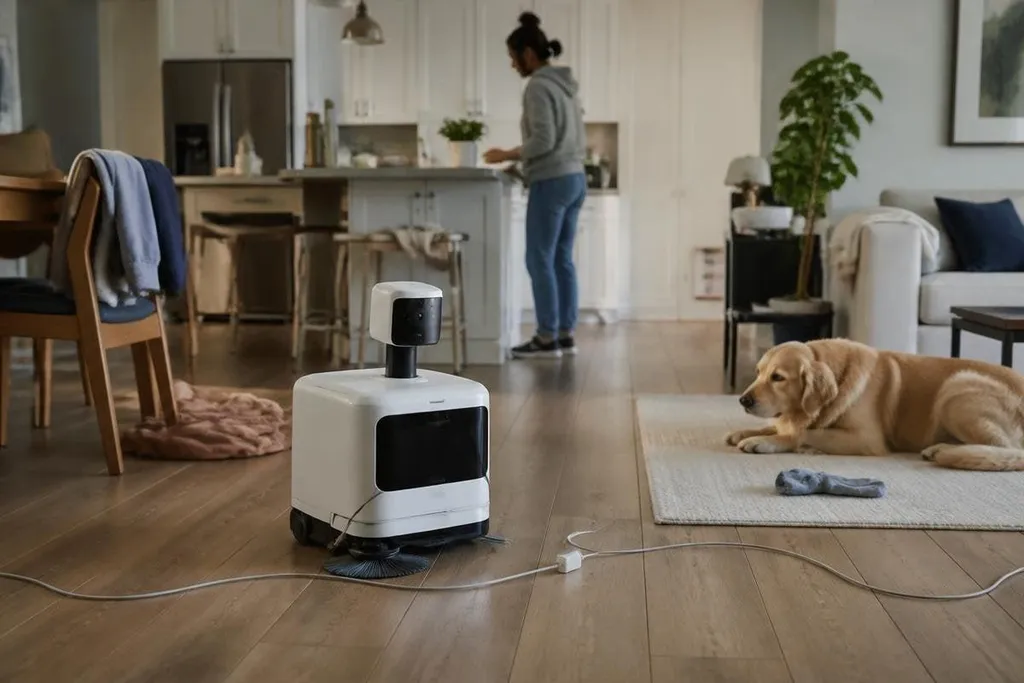
A home robot has to deal with loose cables, changing light, pets, people, and objects left in the wrong place. AI helps it turn sensor readings into a task plan, but the gap between a clean demo and a useful household machine remains wide.
- AI can link a spoken request to a sequence of robot actions.
- Cameras and other sensors help the robot identify objects and avoid obstacles.
- The hard test is repeatable work in a home that changes every day.
What AI adds to a home robot
Older robot systems often depended on fixed rules. Earlier systems could follow a map, avoid a wall, or repeat a route, but each task had to be described in advance. AI lets the system connect a goal with several steps instead of waiting for one command at a time.
A request such as “bring me the charger” still needs careful work. The robot must find a charger, decide which object matches the request, choose a safe path, reach the object, and carry it without dropping it. Each step can fail for a different reason.
That is why a language model alone can't make a useful home robot.
The robot also needs cameras, motor control, location tracking, and software that checks whether an action worked. The language model can help choose the next step, while the control system handles movement and safety.
The home is a hard place to work
A factory gives robots marked areas, fixed tools, and repeatable routines. A home offers none of those conditions. A chair moves, a blanket folds over an object, and a glass may look different when sunlight hits it.
AI can help a robot sort these changing inputs. A vision system can label an object or estimate its position. A mapping system can record the shape of a room. A planning system can then choose a route that avoids furniture and people.
The robot still needs a way to recover when its guess is wrong. If a gripper misses a cup, the system has to notice the failure, move again, and avoid pushing the cup onto the floor. Recovery matters more than a smooth first attempt because household tasks rarely happen in perfect order.
Where the useful gains may appear first
Home robots will likely get value from tasks with clear goals and limited risk. Floor cleaning already fits that pattern because the robot can cover a defined area and return to a dock. Other tasks need more careful handling because a mistake can damage an object or injure someone.
The same AI methods may help with room checks, object finding, and basic delivery inside a house. Each use still depends on the robot's camera view, battery, gripper, software limits, and ability to ask for help when it cannot decide.
A home-robot claim needs more than a smooth demo: it needs the named machine, task, test date, and point where a person took over. Home robotics reporting from Robot24.com can put those details beside claims about household tasks before the next section examines what still lacks proof.
What remains unproven
A short video can show a robot completing one task. It does not show how often the task succeeds, how long setup takes, or what happens after a failure. Those details decide whether a household robot saves work or adds another system to manage.
Privacy also needs a clear answer. A robot that uses cameras and microphones may send data to a remote server, store it at home, or process it on the robot. Buyers need to know which data is kept, how long it remains available, and who can access it.
I’d wait for published results across many homes before paying for broad household claims. A robot that completes one neat demo may still need a person nearby for the tasks that matter most.
A buying checklist for home robots
Use these checks before you compare features or prices:
- Name the task: Write down the exact job, such as finding objects or cleaning one room.
- Check the failure plan: Find out how the robot reports a blocked route, empty battery, or missed object.
- Read the privacy terms: Look for camera storage, microphone access, cloud processing, and account rules.
- Measure the home: Check door widths, floor types, steps, clutter, and the space around charging points.
- Ask about updates: Confirm how software updates arrive and what happens if support ends.
AI can make a home robot better at interpreting requests and adjusting to small changes. It can't remove the physical limits of motors, batteries, sensors, or grippers. The useful question for newer home robots is not how much the robot can say, but how many ordinary tasks it can finish without being rescued.